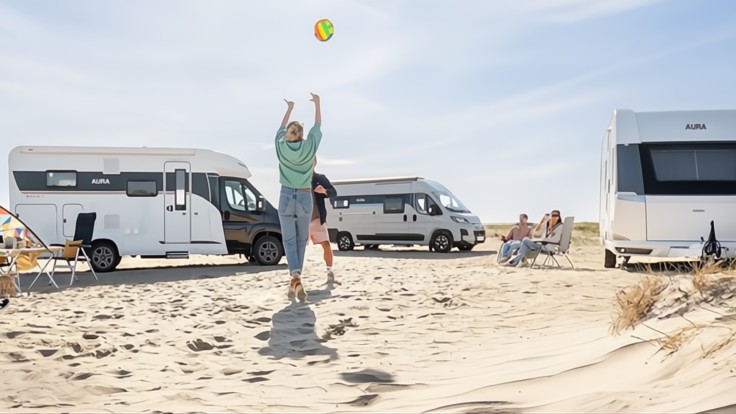
Europe’s largest caravan manufacturer has decided its own name is worth less in the UK than a badge that is two years old.
That is the real story behind Hobby’s launch of Aura at this month’s Motorhome and Caravan Show. On the surface it reads as a rebrand. Look closer. A company that sells tens of thousands of vans a year across Europe has looked at the UK and chosen to hide the word “Hobby” from the forecourt.
A brand does not retire its own name in one of the world’s richest caravan markets because things are going well. It does it because the name is holding the product back. That distinction matters, and it is the part every dealer should read closely.
What Hobby Has Actually Done
From the October show onward, almost every new caravan, motorhome and campervan that Hobby builds at its Fockbek factory in northern Germany and sells in the UK will carry the Aura name instead. The one exception is the entry-level Beachy caravan, which keeps the Hobby badge. No new Hobby-branded stock will be imported beyond that.
Aura is not a name Hobby invented. It was a campervan-only brand set up around two years ago by Mike Lake, the former UK agent for Knaus and Weinsberg. Hobby has taken that brand over, moved its production to Fockbek, and widened it to cover caravans, campervans and low-profile motorhomes. Lake has become Aura’s head of sales and marketing.
This is a clean-sheet relaunch, not a sticker change. The range is built to UK taste rather than adapted from Continental layouts. That means single-axle tourers in place of Hobby’s traditional twin-axle designs, front lounges, UK-spec interiors and a 12-year water-ingress warranty.
At the NEC, Aura showed 18 vehicles across its Beachy, De Luxe and Prestige ranges. The Prestige caravans sit at the top, with three 8ft-wide models, a 157-litre Dometic fridge, Truma Combi 6 heating and prices from £38,995.
Clemens Schmidt, Hobby’s head of international sales, was blunt about why. He described the UK as a “special” market and said a fresh name made it easier to build a new dealer network, including dealers who would not have wanted the Hobby badge over the door. Five have signed so far in six locations, in Devon, Somerset, Norfolk, Cumbria, South Yorkshire and North Lanarkshire.
Why a Global Brand Buries Its Own Name
Here is the blunt truth. Build quality was never Hobby’s problem in the UK. Fit was.
Hobby builds to German standards and sells hard across Europe. But the German product was built for German and Continental buyers: twin axles, side dinettes, layouts that suited their market, not ours. UK buyers wanted single axles and front lounges. For years the badge arrived carrying a product that did not quite match what the British customer was looking for, through a dealer network that never fully took to it.
So the name picked up baggage. Not from poor engineering, but from a long mismatch between a good product and the wrong market fit. Schmidt’s “special market” comment is a polite way of saying the UK never bought Hobby the way the company wanted it to.
The move Aura makes is the logical one. Keep the German factory and the build quality. Drop the name that carries the baggage. Re-engineer the product for what UK buyers actually ask for. Hand it to someone who has spent years selling German vans into UK dealerships and knows the network personally.
The signal for the wider trade is this. A brand’s reputation and its product quality are two different assets. They do not always move together.
Hobby has concluded its UK reputation is worth less than the cost of a clean start. That is a striking admission from the biggest name in the category. ADRIA made a milder version of the same bet, rebuilding the Adora for 2026 on the view that a European brand has to be re-engineered for the market it is sold into, not just shipped across the Channel.
What This Means for UK Dealers
Three things to do with this, not three things to note.
Look hard at the franchise if you have a gap, but weigh the risk. Aura offers something unusual: German build behind a UK-tailored product, with no Hobby history attached and only five dealers signed. If you have wanted a European-built range without the baggage, this is a live option early.
The catch is real too. You would be backing a brand the public has never heard of, in a flat market, asking buyers to pay from £38,995 for a name with no residual-value track record yet. That is a harder first conversation than a known badge.
Do not take the “new demand” framing at face value. Check it. A rebrand does not create buyers. It redirects the ones Hobby already had and tries to win a few who would not look at the old name.
Before you commit stock or showroom space, pull the search demand for the layouts Aura is leading with. Our Used Demand Index showed family berths growing while the premium end softened this summer. A single-axle, front-lounge, UK-spec range aims squarely at the part of the market that is holding up. That is in Aura’s favour. Confirm it against your own patch before you order.
Read the single-axle pivot as a market signal, whoever you stock. The most important fact here is not the name on the badge. It is that Europe’s largest caravan maker has retooled its entire UK range around single-axle tourers with front lounges. If that is where the biggest player is aiming, it tells you where it thinks the demand sits.
This lands in a flat year, with show footfall down and the real wins in leads rather than the gate, and with motorhome volumes still outrunning caravans. Aura is fighting for a bigger slice of a market that is not growing. That makes product fit matter more, not less.
What It Means for Buyers and Existing Hobby Owners
For new buyers, the pitch is simple enough: German build, UK-spec layout, strong warranty, fresh name. The honest caveat is residual values. A badge with no history behind it has no second-hand track record, and that is a fair question for a buyer spending this kind of money. The answer is time, not spin.
For the UK owners who already have a Hobby on the drive, the disappearing name raises practical worries about parts, servicing and resale. The factory and the dealer relationships behind Aura are the same Hobby operation, so the engineering support does not vanish with the badge. Dealers should be ready to say so plainly, because owners will ask.
The Signal for Next Year
Aura is a shrewd move, and a revealing one. It is shrewd because it keeps everything that worked, the German factory and the build, and sheds the one thing that did not, the name’s fit with this market. It is revealing because of what it admits: a badge can be rebuilt in a single show season, but a product that never matched its market takes years to recover, and sometimes the faster route is to start again.
The open question is whether a two-year-old name can carry a premium price and win buyer trust from a standing start, in a flat market, through five dealers. That is a real bet, not a certainty, and the next twelve months will settle it.
So here is the question for your dealership. When a product is strong but the badge is not landing, do you keep pushing the name, or do you have the nerve to change it? Hobby just answered that in the most expensive way there is. What is the name on your forecourt doing for you, and what would change if it were different?