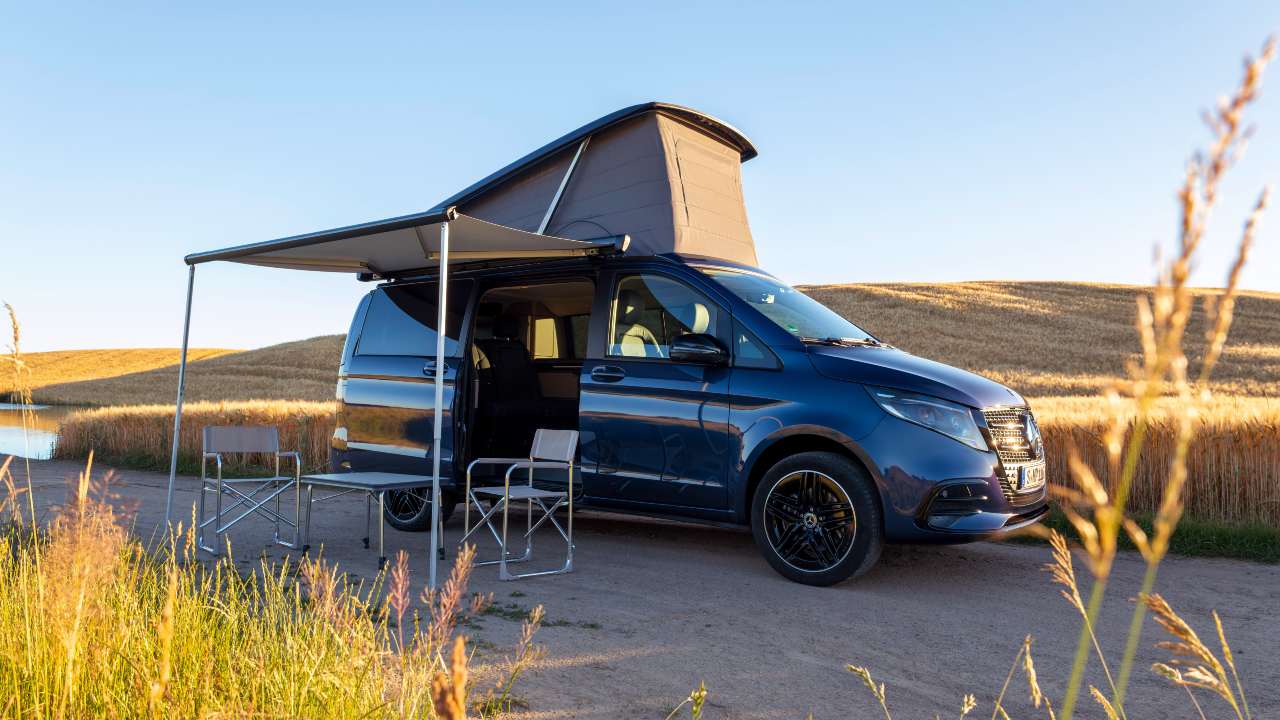
Read the Mercedes press release and you get a comfort story. Ten centimetres more headroom under the pop-up roof. Eight speakers and a subwoofer. Ambient lighting you can set from cool to cosy. A new awning that packs away at the car wash.
All real. None of it the point.
The line that matters sits further down the page, under a dull heading about production. For the first time, Mercedes builds the Marco Polo entirely in-house. The V-Class comes out of Vitoria in Spain, then Mercedes converts it into a camper at its own plant in Ludwigsfelde, near Berlin. No third-party converter in the chain.
That is the news. A premium manufacturer has taken the conversion, the part most campervans still farm out, and pulled it inside its own factory walls.
What Mercedes Has Actually Changed
Strip the comfort list and two things happened at once.
The product got a mid-life refresh. The living area gets the new double-skinned aluminium pop-up roof, the extra headroom, the redesigned awning, a magnetic cab blackout system and the updated MBAC smart-home control. A sliding roof and a panorama opening in the pop-up canvas join the options from the end of the year. Mercedes says orders opened across Germany and other European markets from 6 August.
The build moved home. The outgoing Marco Polo leaned on Westfalia, the long-standing conversion specialist, for part of the build. The new one drops that. Mercedes says this is the first time it relies entirely on in-house production: the V-Class is now converted by Mercedes, in a Mercedes plant, inside the Mercedes-Benz Vans production network. The company says this locks in quality standards and opens the door to faster delivery times.
One of those changes is a trim update. The other is a change to who controls the product.
Why the In-House Build Is the Story
A campervan is two businesses stitched together. A base vehicle, and a conversion. For decades the base vehicle came from the manufacturer and the conversion came from someone else. That split is the whole shape of the UK campervan trade.
Mercedes has now closed the split on its own flagship.
Look at who else is circling the same move. Volkswagen builds the California in-house and sells it as a factory product, priced in the UK from £63,376 for the Beach up to £77,476 for the Ocean. Ford has tightened the rules on who can convert its vans and call the result a camper. Citroen brought its own Holidays camper to the UK.
The direction of travel is one way. The big vehicle makers want the conversion margin, the warranty control and the brand on the finished camper, not just the panel van underneath.
That is the signal. Not “Mercedes improved the roof.” Mercedes decided the conversion was worth owning.
For a premium badge, owning the build is how you defend it. A factory camper carries one warranty, one quality standard and one company to blame when something goes wrong. An independent conversion on a bought-in van usually splits that between the vehicle maker and the converter. At this end of the market, buyers weigh that difference.
What This Means for UK Campervan Dealers and Converters
The UK market is healthy, which makes this worth your attention rather than a shrug. New campervan and motorhome registrations hit a record 16,668 in 2025, up 1.3% on the year before, on European Caravan Federation and NCC figures. The money is real and it is growing.
Here is the uncomfortable bit for the conversion trade. Every factory-built camper is a conversion job that no longer exists.
It is already here. Mercedes-Benz Cars UK has put the new Marco Polo on sale, available to order now, with the first cars arriving from late summer. The camping-focused Marco Polo Horizon starts at £52,405, the full Marco Polo with the kitchen at £57,550, both on the V 220 d. The more powerful V 300 d takes those to £56,595 and £61,740. Two diesels, no hybrid at launch.
So the question is not if, but what it does to you. If you sell or convert on a Mercedes base, put three blunt questions to your area rep this month. How many can you actually get, and on what demo and stock terms? What does it do to the supply and pricing of the V-Class and Vito you build on? Does Mercedes still want your conversion business, or is it now competing with you for the same buyer at the same price?
For dealers, the action is about where you stand. A factory camper with a Mercedes warranty is easy for a customer to trust and hard for an independent build to argue against on paper.
If you sell converted vans, your pitch has to move off the spec sheet. Sell what a factory cannot give: layout choice, local service, faster turnaround, a relationship after the sale. Spec alone is a losing argument against a three-pointed star.
If you are a converter, the independents show the counter-move. Bailey’s Endurance E62 and Wellhouse’s electric Kia camper both sold on being something the big factories do not offer. That is the ground to hold. Build what Mercedes will not.
What This Means for Buyers
For the person writing the cheque, the in-house build is good news, and it is fair to say so plainly.
One warranty. One company accountable for the van and the camper kit together. Tighter quality control on the conversion, which is where cheap campers tend to fail first. At this money, a single line of responsibility is worth paying for.
And the price is the proof of the in-house story. The full Marco Polo starts at £57,550, the Horizon at £52,405. The VW California starts at £63,376. Mercedes has come in under its direct rival, on a premium badge, with a factory warranty covering the whole van. That is what owning the conversion buys you: the room to set the price where you want it.
The trade-off is choice. Factory campers come in factory layouts. The buyer who wants a bespoke interior, an unusual bed arrangement or a specific base vehicle still needs an independent converter. That buyer has not gone away. They have just become easier to tell apart from the buyer who wants a safe, badged, sorted product off the shelf.
The Bigger Takeaway
The Marco Polo refresh will sell on headroom and sound systems. That is the showroom story, and it is fine.
The trade story is quieter and bigger. The companies that make the vans increasingly want to make the campers too. Volkswagen already does. Mercedes now does, and Ford and Citroen are leaning the same way. Each factory conversion pulls work out of the independent trade and warranty control back to the manufacturer.
If your business is built on converting other people’s vans, the question is no longer whether this reaches your corner of the market. It is what you sell when the people who supply your base vehicles decide they would rather sell the finished camper themselves.