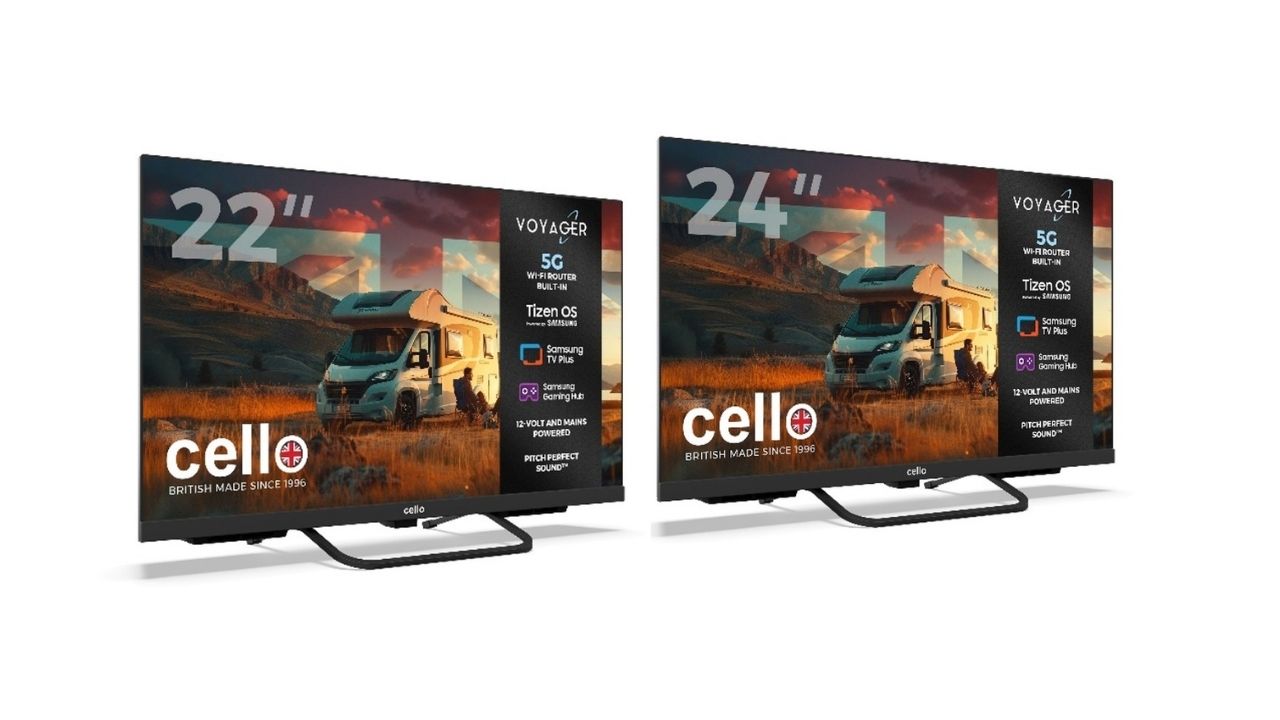
Cello has put a 5G mobile router inside a 12V television.
Put a SIM in the back of the Voyager and it becomes the Wi-Fi hotspot for the whole van. No MiFi unit, no separate router, no extra cabling. One box does the screen, the streaming and the internet.
Cello calls it the world’s first 12V smart TV with a built-in 5G router. We couldn’t find an earlier one in the leisure market, so the claim looks fair.
The more useful question for a dealer is simpler. What happens when a customer takes it somewhere the signal is poor?
What Cello Has Actually Built
Strip out the launch language and the Voyager is three things in one case:
- A 12V/240V smart TV running Samsung’s Tizen platform, with Netflix, Prime Video, Disney+, YouTube, iPlayer and Freesat.
- A SIM-lock-free 5G router that Cello says can serve up to 32 devices.
- Built-in speakers, two 6W units according to Cello’s product pages.
It comes in two sizes. The 22-inch costs £449.99 and the 24-inch £469.99. It’s built at Cello’s factory in Bishop Auckland, County Durham, where the company says it has made televisions since 1996.
The Voyager first appeared in May and is now listed by Cello direct and by leisure retailers including Towsure.
Look Closer at the Spec Sheet
The press release promises dual SIM slots and a Wi-Fi 6 network. Cello’s own 24-inch product page now lists one physical SIM plus an eSIM, and notes that earlier advertising showed two slots.
That’s not a scandal. It is a reason to check the current spec before you write your own product page or brief your sales team.
Three other gaps matter more:
- External antenna. The page lists an “RF Antenna” connection but doesn’t say whether it serves the 5G modem or the TV tuner. A router inside a TV sits wherever the TV sits, behind an aluminium skin. Dedicated leisure router kits, such as Avtex’s AMR104P, ship with an external MIMO antenna for exactly that reason.
- Router with the screen off. Can the hotspot run while the TV is in standby? If not, the family’s phones lose Wi-Fi whenever the TV goes off. If it can, what does it draw from the leisure battery overnight?
- 4G performance. The spec says 5G NSA/SA. Non-standalone 5G leans on a 4G network, so it should work on 4G, but Cello doesn’t say how it performs there.
Why It Matters: 5G Coverage Stops Where Campsites Start
Cello says the Voyager works “wherever there is mobile signal”. That’s true, and it’s also the catch.
Ofcom’s Connected Nations 2025 report puts outdoor 5G coverage at around 97% of UK premises from at least one operator.
By landmass, the picture changes. EE, the best-covered network, reaches 42% to 49% of the UK’s land area with 5G. Vodafone reaches 9% to 17%.
Premises are towns and villages. Campsites are often neither.
So the Voyager will spend plenty of its life on 4G, or hunting for any signal at all. That doesn’t make it a bad product. It means the buyer’s experience depends on their network, their pitch and where the TV is mounted, not just the TV.
This isn’t just a new TV. It’s another sign that the van’s entertainment now runs on the internet, not the aerial. We covered the same shift when Cello started shipping Freely TVs, and connectivity is now a sales question in its own right, as the Truma iNet Box 2G sunset showed.
What This Means for UK Dealers
If you sell accessories, fit TVs in the workshop or hand over vans, here’s what to do this month:
- Ask Cello four questions before you stock it. SIM setup (two slots or one plus eSIM), external antenna support for the modem, hotspot power draw with the screen off, and how the warranty treats the router.
- Test one in a closed van on your forecourt. Put a SIM in, shut the door and run a speed test at the TV and at the far end of the van. Now your staff can answer “will it work in mine?” with a fact, not a guess.
- Sell the data plan conversation, not just the TV. Netflix says HD streaming uses up to 3GB an hour. Two hours a night on a two-week trip is up to 84GB. Customers on small data bundles need to hear that at the till, not on night three.
- Think about mounting in the workshop. The TV position now decides the router position. If you fit it, check signal at the bracket before you drill.
- Answer the search question. Owners search “do I need an aerial in my caravan” and “best Wi-Fi for motorhome”. A product page that answers both, honestly, will outsell one that copies the release.
Let’s be fair to Cello. For owners who want one box and fewer cables, this is a neat answer, and it’s built in Britain. Your job is to sell it to the right customer.
What It Means for Owners
The upside is real. One device, one power supply, fewer things to set up on every pitch. Cello’s pages list typical consumption of 15W to 17W, which is modest for a 12V system.
The trade-off is that everything now sits in one box. If the TV fails, the Wi-Fi goes with it. And owners who tour in remote areas may still want a roof antenna or a dedicated router, whichever TV they choose.
The best buyer is someone who mostly stays on sites with decent mobile coverage and wants simple. The worst is someone touring the Highlands who expects 5G on every pitch.
The Signal Is Clear
The van’s TV used to be an aerial, a dish and a box. It’s becoming a screen, a SIM and a data plan.
The dealers who win here won’t be the ones with the most stock. They’ll be the ones who can tell a customer, before they buy, whether it will work where they actually go.
Can your sales team answer that today?