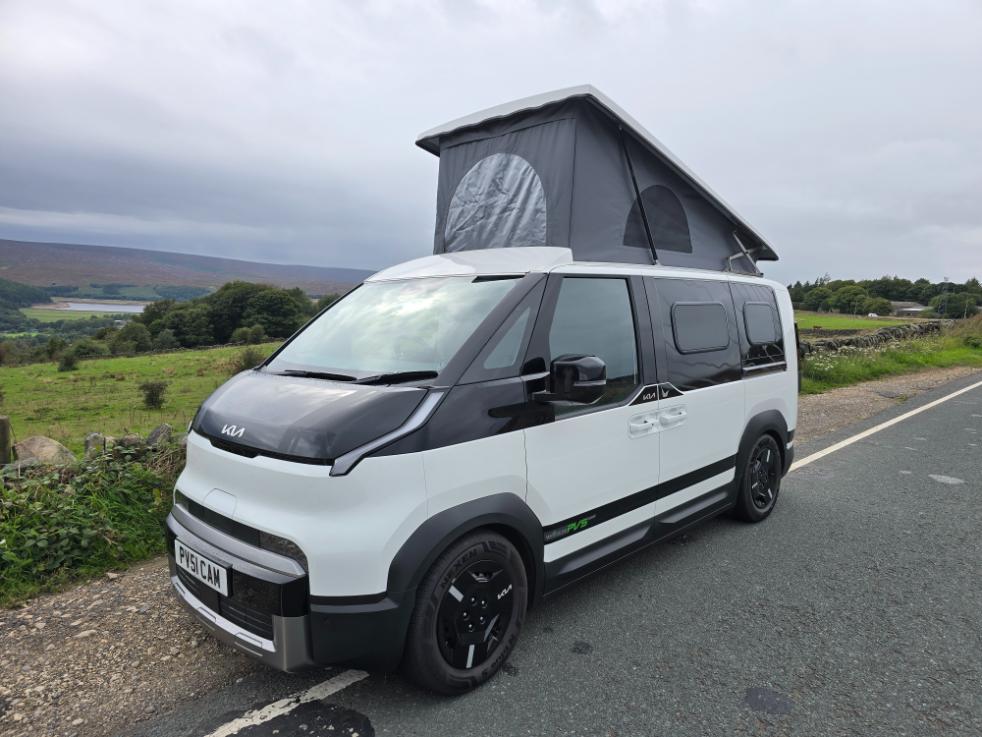
Wellhouse Leisure has finished its first production Kia PV5 i-Camper, a fully electric pop-top campervan built in Barnsley.
The headline isn’t the van. It’s the order book. Wellhouse says customers put down deposits before the first production model was finished, the first batch of 30 is sold, and a second batch is on order.
Thirty vans is a small number. Thirty vans sold largely off the drawing board, at £59,995, on an electric base, is a demand signal the rest of the UK campervan trade should take seriously.
What Wellhouse Has Actually Built
Strip out the launch language and here’s the product.
- Base vehicle: Kia PV5 with the 71.2kWh long-range battery.
- Range: up to 247 miles WLTP, according to Wellhouse. Kia quotes a 10 to 80% rapid charge in around 30 minutes.
- Size: 4.69m long, 1.89m wide, 1.99m high. Small enough for daily driving, though 1.99m is tight for some 2.0m height barriers.
- Beds: four berths. Sliding, reclining, removable rear seats by German maker Schnierle form the lower double. The pop-top adds a second double.
- Kitchen: gas-free. Induction hob, 42-litre electric fridge, optional 700W microwave.
- Off-grid power: 200W solar panel, 150Ah lithium leisure battery, plus Vehicle-to-Load from the traction battery.
- Price: from £59,995 on the road, registered with the DVLA as a motorhome.
The base van has form. In October 2025 a Kia PV5 Cargo covered 430 miles on one charge near Frankfurt, at maximum payload, and took a Guinness World Record.
That was a record attempt driven for range. Don’t expect a loaded camper on the M6 to match it. But it shows the platform has real reach.
You can see the full layout in Wellhouse’s own walkaround:
Why 30 Pre-Sold Vans Matters More Than It Looks
Look closer at who’s buying.
Wellhouse founder David Elliott says most PV5 customers already drive an electric car and don’t want a diesel campervan.
That’s a different buyer to the one most dealers meet. They’ve already decided electric works. They’re asking whether anyone will sell them one.
Until recently, UK choice was limited to a handful of small converters. And interest keeps climbing.
UK searches for “electric campervan” ran at 1,300 a month in October 2025. By September 2026 they reached 1,900, with peaks of 2,900 in April and August, according to Google Ads data.
Supply is now arriving, but it’s thin.
- Sussex Campervans announced a PV5 pop-top in March 2026, with reservations from £68,995.
- Volkswagen’s ID. California Cruise goes on sale in Germany in early 2027, but VW UK has said it won’t come to Britain.
- Wellhouse plans a high-top PV5 in 2027, and a conversion of the larger Kia PV7, which made its debut at IAA Transportation in Hanover in September.
So Wellhouse’s entry price sits around £9,000 below the Sussex reservation price (specs differ, so compare like for like), and it has vans on order while the biggest name in campervans sits out the UK. That’s a real head start, not a niche experiment.
This isn’t just a new campervan. It’s evidence that UK buyers will commit early, at £60,000, to an electric one.
The Small Print Worth Checking
Let’s be fair to Wellhouse and still read the release properly.
NCC Approved status is pending. On Type Approval, the release says two things: its summary lists the van as “Type Approved”, while the body says Wellhouse is awaiting VCA Type Approval.
It also says the conversion complies with Kia’s converter programme. Until the paperwork is confirmed in writing, a buyer is taking some of that on trust.
The range figure needs care too. The release quotes both 247 and 258 miles WLTP in different places. Use the lower figure until Wellhouse confirms which applies, and remember a camper with bikes on the back and the heating on won’t see either.
Wellhouse also says the van keeps Kia’s seven-year warranty and, registered as a motor caravan, can do 70mph on motorways and dual carriageways. (Under UK rules that 70mph limit applies to motor caravans up to 3.05 tonnes unladen.) Both are strong selling points. Both are worth a written confirmation before a customer relies on them.
None of this undermines the product. It’s normal for a first production batch. But it’s exactly what a sharp buyer will ask.
What This Means for UK Campervan Dealers
If your website has no answer to “electric campervan”, you’re invisible to a growing group of buyers who have already made up their minds.
Here’s what you can do this month.
- Ask your converters where they stand. Which of them have an EV base on the way, when, and with which approvals? You need a date, not a “watch this space”.
- Build one honest EV campervan page. Range in real conditions, charging times, Vehicle-to-Load, warranty, speed limits. Answer the questions an EV driver will ask, in their language. Link it from your campervan stock pages.
- Capture the waiting list. If you can’t supply an electric camper yet, take names. The Wellhouse order book shows these buyers will commit early.
- Check your forecourt and workshop. Can you charge a demonstrator on site? Is anyone on your team trained to work on high-voltage vehicles? An EV buyer will ask both.
- Brief your sales team on charging. Campsite hook-ups, rapid chargers on popular touring routes, and how long a top-up takes. Our coverage of the NCC’s free EV towing guide is a useful starting point for the wider conversation.
Converter rules are tightening too. Kia’s converter programme sits alongside moves like Ford’s stricter campervan conversion rules.
Base-vehicle makers want more control over what gets built on their vans. Stock compliant conversions and you protect your customers and yourself.
What It Means for Buyers
For the buyer, the PV5 i-Camper answers the two questions that held electric campervans back: is there one worth buying, and can it go far enough?
At 247 miles WLTP, it suits weekends and UK touring with a planned charging stop. It won’t suit someone who wants to cover 400 miles a day to the south of France without thinking about it.
The gas-free layout also removes gas checks from the servicing list. For many first-time campervan owners, that’s one less thing to worry about.
Where This Goes Next
A year ago, electric campervans in the UK were a small-batch curiosity. Today there’s a sold first batch, a rival on the way, and a high-top and a larger PV7 version in Wellhouse’s plans.
The buyers are already searching. The question is whether they find you or a converter selling direct from a factory in Barnsley.
Compare this with the diesel launches we’ve covered, such as Bailey’s Endurance E62. Then ask yourself: when an EV driver walks onto your forecourt next spring, what will you show them?