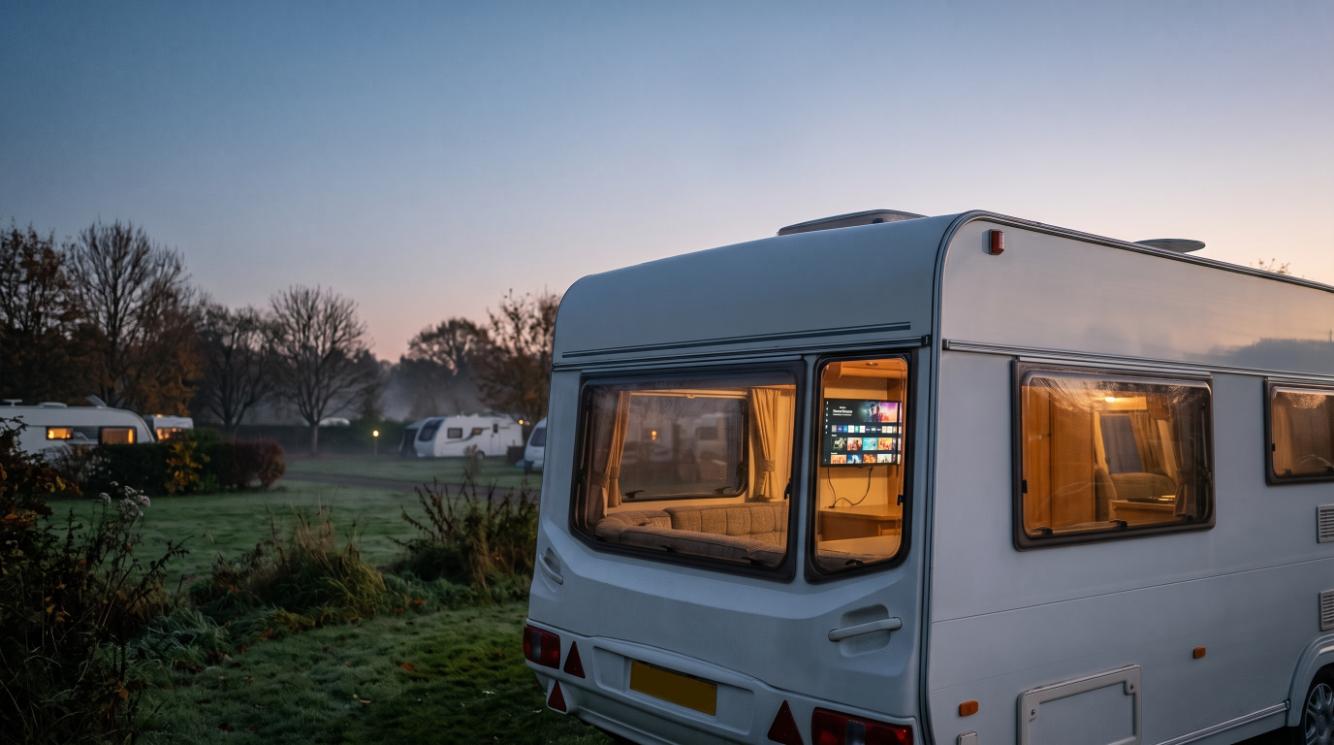
Cello Electronics has started shipping TVs with Freely built in. The 32-inch and 43-inch Smart Frameless sets are on sale now at £159.99 and £249.99, with 24-inch and 50-inch models to follow.
Cello calls itself the UK’s last TV manufacturer and builds the sets on its own line in Bishop Auckland. That’s the headline.
The more useful story sits behind it. Free TV in Britain is moving from the aerial to broadband, and the government sees a strong case for finishing that move by 2034. Every caravan, motorhome and holiday home with an aerial on the roof is part of that.
What Cello Has Actually Launched
Let’s break it down.
- Freely plus tuners. Cello’s product pages list “built-in tuners for satellite and Freeview TV”. The aerial and the dish still work.
- Two sizes now, two to come. The 32-inch C32RK and the 43-inch 4K C43RK4K are live on Cello’s website.
- A hospitality mode. Cello pitches it at hotels, B&Bs and guest houses that want to drop satellite or cable deals.
- Mains sets, not touring sets. We’re checking whether the new TVs run on 12V. Cello’s leisure TVs sit in its separate Traveller range, which still runs webOS with Freeview Play.
Freely itself launched in April 2024. It comes from Everyone TV, the joint venture owned by the BBC, ITV, Channel 4 and Channel 5.
It streams live channels over broadband, with no aerial and no subscription. Everyone TV says Freely passed one million users after doubling from 500,000 between September and December 2025.
Cello Isn’t First to Freely in Leisure
Look closer, and Cello hasn’t brought Freely to its touring range yet. A rival already has.
Avtex already sells SmartPRO mobile TVs with Freely, from 18.5 to 32 inches, through leisure retailers such as Towsure. They run on 12V, 24V or 240V. The 24-inch AV24TS lists at £429 and keeps terrestrial and satellite tuners.
In the home market, Hisense, Toshiba, Panasonic, Sharp, TCL, Bush and Amazon’s Fire TVs all carried Freely before Cello.
So Cello’s real claim is narrow: the first Freely TVs built in Britain. That’s a fair selling point for buyers who care where things are made. It isn’t a first for the technology.
Why the Aerial Question Matters Now
In June 2026 the government published its media Green Paper, Watch This Space. It set out two options for terrestrial TV:
- Move viewers to internet TV by 2034, when the current broadcast licences end.
- Run a hybrid of aerial and internet TV until 2044.
ISPreview reported that the government sees a strong case for 2034. The consultation closed on 31 August. The government has promised a final decision later this year.
Everyone TV’s own forecast puts Freely in 10.5 million homes by 2034. It expects homes relying on terrestrial TV to fall below one million.
Nothing switches off yet. But the policy debate is about fixed home broadband. A caravan on a pitch in Northumberland doesn’t have that.
What This Means for Caravan and Motorhome Dealers
A van you sell this year will be eight years old in 2034. Its owner will ask whether they still need the aerial long before then.
Here’s what you can do this month:
- Brief your sales team. Freely needs broadband. Freeview needs an aerial. Most current leisure TVs do one or both, and buyers mix them up.
- Check your stock. Find out which TVs your 2027 ranges fit as standard, and ask your manufacturer reps whether Freely-capable sets are on the way.
- Sell the connection with the screen. A 4G or 5G router belongs in the same conversation as the TV. Add it to your handover checklist.
- Stock the upgrade. A 12V Freely set is an easy add-on sale for existing owners. If accessories aren’t pulling their weight yet, your spares and accessories counter is the place to start.
- Answer the question online. Owners already search for how to watch TV in a caravan without an aerial. A short FAQ on your product pages answers it before a rival does.
The van is turning into a connected product. That’s the same shift behind Truma bringing on-board electronics into one control system.
What This Means for Holiday Park Operators
This is where Cello’s launch lands most directly.
Holiday homes and lodges run on mains power. Many parks already supply Wi-Fi. A 32-inch set with a hospitality mode at £159.99 is a cheap fit for a letting fleet.
Here’s the uncomfortable bit. Freely over Wi-Fi means every unit streaming at once on a wet August evening. If your network can’t carry it, the TV buffers and the complaints land at reception.
Before you swap aerials for Wi-Fi:
- Test your network at peak occupancy, not on a quiet Tuesday.
- Keep your aerial system while sets still carry tuners.
- Ask Cello what its hospitality mode does. The product pages don’t say, and you need to know whether it locks settings or resets between guests.
What This Means for Owners
Owners don’t need to change anything yet. The Cello and Avtex Freely sets both keep a terrestrial tuner, so the aerial still earns its place.
The catch is data. Free Wi-Fi on Caravan and Motorhome Club sites runs at up to 1Mbps, and the Club says it isn’t suited to streaming.
Premium Wi-Fi at up to 100Mbps costs £5 a day or £35 a year. Away from Club sites, it’s your own mobile data.
The Bigger Signal
The TV in a caravan used to be a box that needed an aerial. It’s becoming a screen that needs a connection.
Cello’s launch won’t change your sales this winter. The policy behind it will change what your buyers expect within the life of the vans on your forecourt.
So when did your sales team last talk to a buyer about Wi-Fi?